
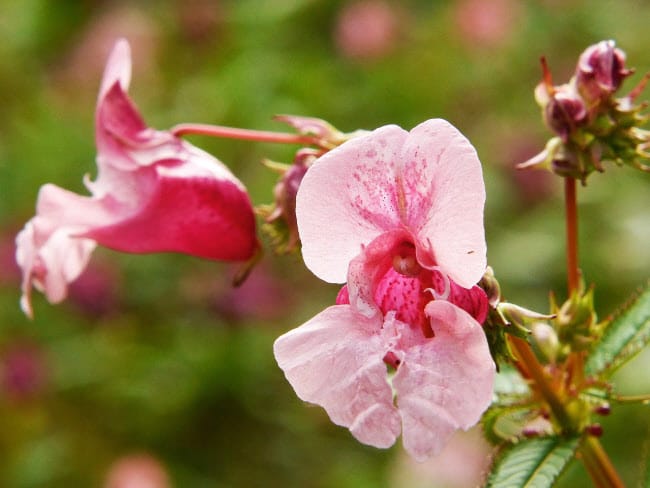
It has been said that weeds are only flowers in the wrong place. A reminder that many plants we uproot as weeds in our gardens are beautiful wild flowers valued by pollinating insects. But some plants are certainly in the wrong place.
Plants which have been introduced from abroad such as Himalayan Balsam (Impatiens glandulifera) which thrive and crowd out native species. Too it late it became clear how easily spread and harmful it is, though now it is illegal to plant or propagate it. Other invasive species now banned are well known, such as Japanese Knotweed (Reynoutria japonica) and Giant Hogweed (Heracleum mantegazzianum). Also banned are New Zealand Pigmyweed (Crassula helmsii) and Skunk Cabbage (Lysichiton americanus). A patch of the latter was discovered and eradicated by Mick and Sue Denness when bashing balsam. It may be surprising to learn that Rhododendrons (family Ericaceae) are also rightly classified as invasive. Unless controlled, they can spread by layering. They are an example of a species, native to the Himalayas, introduced for their beauty but unaware of the consequences.
Giant Hogweed comes from the Caucasus region and was brought to the UK as an ornamental plant. Its sap is toxic to us and causes blisters.
Skunk Cabbage, so named because of its smell. It was introduced from North America in 1901, again as an ornamental plant. Inevitably it spread to marshy areas across the UK. It is toxic if eaten.
New Zealand Pigmyweed is an aquatic plant which thrives in pool margins, grows rapidly forming dense carpets. It does not die back in winter so needs to be controlled.
Japanese Knotweed is native to East Asia, it crowds out other species and is tolerant of a wide range of temperatures and drought. It has deep penetrating roots which makes eradication difficult.
These invasive plants, which have no natural enemies in this country, need our intervention if native species are to survive. Join the Conservation Society and have fun bashing the beasts!
Throughout July/August over several sessions we continued uprooting Himalayan Balsam in Hurston Warren, Monkmead Woods and Cootham Woods.
Our work party met on 9th August at 10am at Dyke Farm. Meadow hay raking and weeding the hedge trees planted last year. This provides vital habitats and corridors for small mammals and birds.
Our next work party is on 6th September at 10.00am on Chantry Hill to clear more damaging scrub to preserve the chalk grassland. We meet at Greyfriars Stable, sharing transport where possible. Gardening clothes and gloves are suggested, other equipment is provided. As ever, more hands make light work, so come and join us.
For information about this and our other activities, or on becoming a member, or offering advice, please get in touch with Chairman Mick Denness on 01903 745971, or see our website: www.storringtonconservation.org.uk/.
Submitted to the Storrington Community Website using the News Item contact form.